
Who Will Truly Bank Pakistan’s Unbanked?
For many of us, living without a bank account or debit card is hard to imagine. Yet in Pakistan, this is the reality for nearly 1 in every 4 adults, where only 23%1 of the population has access to formal financial services. Despite explosive growth in mobile connections and internet use, millions remain excluded from even the most basic financial tools.
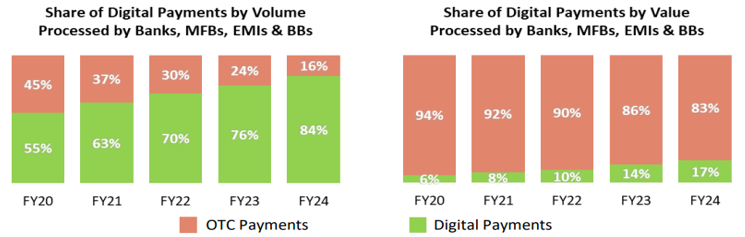
This gap has fueled a critical debate: should Pakistan’s future of financial inclusion be driven by Electronic Money Institutions (EMIs) with their nimble, mobile-first solutions, or by digital banks offering full-scale services? Both promise to transform access, but which model is truly better suited to close the financial inclusion gap?
| Serial. No | Name | Type | Details |
|---|---|---|---|
| 1 | EasyPaisa Digital Bank Limited | Digital Bank | Commercial, Operations Financial Inclusion |
| 2 | Mashreq Bank Pakistan Limited | Digital Bank | Expansion & Customer Acquisition, Digital Innovation, Financial Inclusion |
| 3 | Hugo Bank Limited | Digital Bank | Digital Banking Setup, Customer Empowerment |
| 4 | KT Bank Pakistan Limited | Digital Bank | Digital Banking Launch, Innovation and Growth |
| 5 | Raqami Islamic Digital Bank Limited | Digital Bank | Shariah Compliant Services, Digital Expansion |
| 6 | M/s NayaPay Pvt. Ltd. | EMI | E-money wallet for Consumers, E-money wallet for Merchants |
| 7 | M/s Finja Pvt. Ltd. | EMI | E-money wallet for Consumers, E-money wallet for Merchants |
| 8 | M/s SadaPay Pvt. Ltd. | EMI | E-money wallet for Consumers, E-money wallet for Freelancer |
| 9 | M/s Akhtar Fuiou Technologies Pvt. Ltd. | EMI | E-money wallet for Consumers, E-money wallet for Farmers |
| 10 | M/s E-Processing Systems Pvt. Ltd. | EMI | E-money wallet for Consumers, E-money wallet for Merchants, E-money wallet for Agents |
| 11 | M/s Wemsol Pvt. Ltd. | EMI | E-money wallet for Consumers & Merchants, Payment Gateway for Merchants |
Electronic Money Institutions (EMIs) have quickly emerged as one of Pakistan’s most promising digital finance models. As of 2025, six players, including NayaPay, SadaPay, Finja, Akhtar Fuiou Technologies, E-Processing Systems, and Wemsol, are live with licenses from the State Bank of Pakistan (SBP)2. Their mobile-first approach centers on wallet-based services for consumers, merchants, freelancers, and farmers, alongside payment gateways that make everyday digital transactions simpler and more accessible.
Operating under a structured four-stage licensing regime, EMIs face strict requirements on capital, risk management, and consumer safeguards. With a minimum PKR 200 million3 startup capital and ongoing compliance tied to outstanding balances, these firms must balance agility with resilience. Their revenue streams remain limited, mostly transaction fees and government securities investments, since they are not allowed to lend without an additional NBFC license4. Transaction caps and stiff competition from banks and microfinance institutions further squeeze margins. While their sleek user interfaces and youth-focused design have accelerated adoption, much of this growth has been concentrated in big cities, where players like SadaPay and NayaPay have built their strongest presence. The very promise of EMIs is to reach the underserved, yet meaningful penetration into rural and low-income communities remains limited. Closing this urban-rural gap will be essential if EMIs are to deliver on their inclusion mandate.
Regulatory reforms in 2023 have both tightened oversight and expanded opportunity. EMIs can now pursue cross-border payments, inward remittances, escrow services, and higher wallet limits, including for freelancers, a $400M5 export remittance market with over 3 million workers. They are also being pushed toward interoperability with banks, Raast, and other digital players. This creates a clear opening: EMIs can build on their speed and flexibility to serve Pakistan’s vast freelancer base, small businesses, and informal economy through integrations with global platforms and innovative partnerships. The question is whether they can seize this chance to move beyond wallets and become true engines of financial inclusion.
Digital banks represent Pakistan’s next big experiment in financial inclusion. Despite a 127%1 increase in formal bank accounts between 2019 and 2024, less than half the population remains connected to the formal system. The traditional model, built around costly physical branches, has struggled to reach rural areas, MSMEs, and low-income groups. With only 14 branches per 100,0006 adults, millions remain excluded, leaving digital-first banking as a transformative alternative.
Momentum has grown rapidly in recent years. Mobile banking app users climbed to 18.7 million1 in FY2024, internet banking users surpassed 10 million, and e-wallet adoption soared by 85%1 to 7.7 million. Point-of-sale networks also expanded nationwide, reflecting how consumer behavior is shifting toward digital channels. Digital banks are positioned to ride this wave of smartphone penetration and connectivity, offering cost-efficient, technology-driven services to underserved segments.
Recognizing this potential, the State Bank of Pakistan introduced a digital banking licensing framework in 2022. Unlike earlier models that only allowed existing banks to add digital channels, the new regime established full-stack digital banks through a phased approach: pilot licenses first, then full commercial operations. Importantly, conventional banks were excluded, giving new entrants the space to innovate and drive inclusion without being overshadowed by incumbents.
Still, the path is far from easy. Digital banks require heavy upfront investment, often more than $50 million1, and profitability can take five to ten years. They must also compete with conventional banks’ established low-cost deposit bases while navigating Pakistan’s unique challenges: uneven digital literacy, cash dominance, and high customer acquisition costs. Add to that cybersecurity and liquidity risks, and it’s clear that while digital banks could reshape Pakistan’s financial landscape, their long-term success will depend on resilience, innovation, and investor patience.
Both EMIs and digital banks bring unique strengths to the table in Pakistan’s push for greater financial inclusion. EMIs have proven agile, offering wallet-based solutions tailored to freelancers, small businesses, and the informal economy, while regulatory reforms continue to broaden their scope. Digital banks, on the other hand, promise a more comprehensive model, leveraging full-service platforms and new licensing frameworks to reach underserved populations at scale.
Yet both face significant hurdles, EMIs with their restricted revenue models and intense competition, and digital banks with their high capital requirements and long road to profitability. With millions still excluded from formal financial services despite rising digital adoption, the challenge is urgent and the stakes are high.
The question that remains is not whether digital finance will transform Pakistan, but which path, nimble EMIs or full-scale digital banks, will prove most effective in delivering that transformation. What do you think: are EMIs the faster, more practical answer, or will digital banks ultimately reshape the financial landscape?
Authored by Subhan Bin Salik
